Mostrando entradas con la etiqueta Mergers and acquisitions. Mostrar todas las entradas

miércoles, 13 de julio de 2011

Eric Schmidt On Google’s Acquisition Strategy | TechCrunch


Google Executive Chairman Eric Schmidt sat down and talked to reporters at the Sun Valley conference in Idaho last week, dropping all sorts of science about Google +, Google China and whether or not we are in a tech bubble, among other things. One of the most interesting nuggets of info relayed was the fact that Schmidt could envision startups wanting to build on top of the Google+ platform, which now has 10 million users in its beta but no API in sight.

“You could image the scenario where the social platform is so successful that you’ve got startups that are building on top of Google + that are so incredibly sexy and exciting that we would pay top dollar very fast … That’s a great scenario because then you know you’re winning,” he said.

According to Schmidt, Google M&A made the decision last year to accelerate the acquisitions of companies below the HSR threshold, or the amount that is subject to FTC notification requirements and a waiting period (currently $66 million). Companies like Punchd are being acquired for $10 million, $20 million and $30 million (versus AdMeld’s $400 million) in order to fill out gaps in Google’s strategy, which now includes social.

Earlier in the talk Schmidt also outlined how Google calculated the amount of money it was willing to pay for the company; Namely, the value of a deal equals the value of the team plus the value of the year it would spend a Google team to create the same product. He emphasized that M&A at Google was very bottoms up, “A product manager that has a problem and [needs to] solve that problem” is the raison d’être of a potential acquisition.

You can listen to all of Schmidt’s commentary on Google M&A during the interview in the sound bites clipped together above.

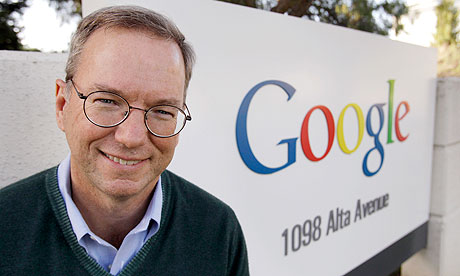
Eric Schmidt: You Don’t Know It’s A Bubble Until The Bubble Ends


Earlier this week, Google Executive Chairman Eric Schmidt gave an over 70 minute long talk to press at the Sun Valley conference here in Idaho. Towards the end of the talk, a reporter asked the former Google CEO whether he, like many in the media world, thinks we are presently in a tech bubble and what Google’s $1.67 billion 2004 IPO at a $23 billion valuation (Google’s current valuation is 171.43 billion) means in light of today’s IPO valuations.

“Oh we were underpriced,” Schmidt joked, before remarking that he didn’t actually know whether or not we are presently in a bubble.

“On the general question of bubble, in the first place you don’t know it’s a bubble until the bubble ends, by definition. The rule I set for myself 10 years ago was that if the press calls it a bubble then I’d pay attention, and let me report that the New York Times, the Wall Street Journal and the Economist have all written articles saying that it’s a bubble.

So you have a couple choices A) The revenue growth possibility on these platforms is so large that you could get the kind of revenue acceleration that justifies the valuations. B) You have a liquidity squeeze where you don’t have enough shares, and they’re artificially high.”

When a journalist pointed out that it sounded like Schmidt was “unconvinced either way,” he said that it’s difficult to know whether the valuations are fair until a significant amount of shares hit the market, usually when employee lockups expire, typically after six months, “You won’t really know the answers until 2012,” he said.

The only clear thing at the moment, Schmidt said, was that real estate values will go up. “Young people who need houses will go into areas of scarce housing resources and there will be competition for houses and housing prices will go up. So for them it’s not a bubble it’s actually a house.”

On what effect if any the seven years of market experience have had on his perspective on Google’s IPO, Schmidt said, “Google went public at a very different time, at what people thought was an unbelievably high valuation, and let me point out that we’ve never traded below our opening price.”

When pressed again by a reporter for a yes or no answer, Schmidt gave the following humble reply, ” I don’t think it’s my job to call the market. It’s a mistake for me to say what the market should think … I’m not a brilliant investor. If I were a brilliant investor then maybe I’d have some status. I’m a computer scientist.” … A computer scientist with a $7 billion net worth.