lunes, 7 de noviembre de 2011

New nanotube battery technology leads to blisteringly fast recharges, improved safety features

BY CHRIS BARYLICK

Some day, your restroom break may be enough time to charge your [insert nifty gadget here] halfway. A group of researchers at the Department of Energy's Argonne National Laboratory has discovered that nanotubes composed of titanium dioxide can switch their phase as a battery is cycled, gradually boosting their operational capacity. The upshot: laboratory tests showed that new batteries produced with this material could be rejuvenated to 50 percent of their maximum charge in less than 30 seconds. This was accomplished by replacing conventional graphite anodes with titanium nanotube andodes. Following the experiment, lead researcher Tijana Rajh and her colleagues noted that as the battery cycled through several charges and discharges, its internal structure began to orient itself in a way that dramatically improved the battery's performance. Furthermore, using anodes composed of titanium dioxide instead of graphite could improve the reliability and safety of lithium-ion batteries and help avoid scenarios in which the lithium can deposit on the graphite anodes, causing a dangerous chain reaction known as "thermal runaway." Copious amounts of related technobabble can be found in the links below, and there's a video just past the break, too.

lunes, 15 de agosto de 2011

By Buying Motorola, Google Can Now Do Whatever The Heck They Want With Android | TechCrunch

Greg Kumparak
Ball

With the announcement of their planned $12.5B Motorola Mobility acquisition this morning, Google is buying a lot of stuff. They’re buying 20,000 employees (almost doubling their headcount.) They’re buying an absurdly daunting armory of over 24,000 patents (I mean, come on: Motorola has the patent on the cell phone.) But there’s one more thing that Google’s buying, and it’s one that shifts up the Android game all together: nearly 30% of Android’s existing marketshare in the U.S.

After years of owning next to none of the hardware marketshare for their own software platform (even the so-called “Google phone” Nexus devices are made by HTC and Samsung), Google has just become Android’s 2nd biggest manufacturer.

At 29%, Googorola sits in the second place seat, just behind HTC (35%) and ahead of Samsung (25%). That stat comes from numbers pulled fresh this morning by mobile analytics firm Localytics.

Some of the things this could mean:

  • Updates For Everyone! Now under the Google umbrella, the pressure on Motorola to keep their Android handsets updated will be stronger than ever… which in turns ups the pressure for everyone else. If Motorola maintains their share and Google keeps a fire lit under them (as they should), nearly 30% of the devices flying off the shelves will be quickly upgraded to each new software release. Other manufacturers will feel the heat to support upgrades as often and as quickly possible, or risk being known as the manufacturer thatdoesnt.
  • The death of the skin? So far, any of the devices that Google has had a direct role in launching run what they call a “pure Google Experience” — that is, it’s Android, straight-up, without any of the custom interface replacements/overhauls that the manufacturers insist on strapping to their own Android devices. HTC has Sense. Sony Ericsson has UXP. Samsung has TouchWiz. Motorola had Motoblur.

    Motorola recently announced that they would be tapering off the development of Motoblur, and now we know why. Google doesn’t want their own handset manufacturer changing up Android — that would imply that something is wrong with Android. While Moto might have one or two more devices in the pipeline with BLUR on deck, expect all of their new stuff to run vanilla Android sooner than later.

    It’ll be interesting to see how this affects other manufacturer’s skinning efforts. Will they fall back to vanilla Android because that’s what most users will come to expect, or will they strengthen their UI tweaking efforts to differentiate their wares?

  • Google could tackle Android’s “fragmentation” by bullying for standard hardware specs Though they tend to be overblown, Android does have fragmentation issues. Among the most annoying, from a development/testing perspective, is the hugely varied selection of screen resolutions used by different manufacturers. How easy would it be for Googorola to say “So, hey guys, we’re only going to use 800×480 displays on our own devices for the next year or so. You don’t have to, but, you know, you probably should.”?

Google just instantly shot from zero to 60 (well, zero to 30% — but you get what I mean) in a race they long pretended to have no interest in. They stood aside and let the major manufacturers raise Android to the top — and now that it’s there, they’re swooping in and taking a commanding control of the hardware side of things. Is it evil? Perhaps a bit. But it’s also downright genius. Marketshare maintained, Google will have final say over what happens to thirty percent of the hardware sitting in pockets, and be able to sway the other manufacturers accordingly.

Expect Android to do nothing but improve, and fast.

domingo, 24 de julio de 2011

Report: Board members discuss Jobs' successor | Apple - CNET News

Steve Jobs takes the stage at WWDC 2011.
(Credit: CNET Staff)


Members of Apple's board of directors have talked to outside headhunters about a succession plan for the company, if it needs to replace Chief Executive Steve Jobs, The Wall Street Journal reported today.


The Journal cited unnamed sources in the story, who said the conversations with recruiters were not aimed at replacing Jobs, who went on medical leave last winter, but rather were more informal conversations regarding the company's options. The Journal also said the members of the board who approached recruiters were not doing so at the behest of the entire board. It's also unclear whether Jobs was aware these conversations were taking place.


Apple declined to officially comment on the Journal's story, but the newspaper reported that in response to its explicit question to Jobs, he responded via e-mail, "I think it's hogwash."

The Journal said conversations between some board members and recruiters took place after Jobs went on his second medical leave in two years. In January, Jobs left his day-to-day duties at the company due to an undisclosed illness. In 2004, he was treated for a rare form of pancreatic cancer. And he received a liver transplant in 2009.


Since then, investors and corporate-governance experts have pushed the company for details about a possible succession plan at the company. Meanwhile, Apple's board of directors has not shared information about Jobs' current health condition, nor has it said when he might be returning full-time to the company. And it has not disclosed its plan for replacing Jobs, should he need to step down permanently.


Last February, a shareholder proposal asking Apple to disclose its succession plan was defeated at the company's annual meeting.


Still, Jobs is believed to still be actively involved in the company, even showing up to his office often. He has also been involved in product and strategy planning, the Journal said. And he appeared on stage in June at the company's annual developer conference. Bloggers and other media tend to make special note of how thin Jobs looks at his public appearances.


Tim Cook, Apple's chief operating officer, has taken over day-to-day activities in running the company. And he is a candidate for the CEO slot, should Jobs leave.


But as the Journal article also notes, the surge in Apple's stock price in the past five years has made many top executives at Apple rich, which could make it difficult to keep executives and promote from within. Ron Johnson, head of Apple's retail strategy, recently left to take the top job at J.C. Penney. And the company has also lost other top executives.

Graph: How long it took Facebook, Twitter and Google+ to reach 10 million users

by Mike Butcher

Norwegian ‘tech evangelist’ Leon Håland of Altibox has created an awesome graph to show the amazing growth of Google+. It doesn’t really require much more explaining than this.

However, it’s not an entirely fair comparison of course. We need to factor in the fact that Twitter and Facebook educated us all about social networking a little earlier, and Google+ is clearly reaping the rewards. In a big way. And let’s not forget the millions who already had Gmail accounts and therefore easy access to a Plus account. Still, it’s interesting when shown in the stark terms above…

miércoles, 13 de julio de 2011

Eric Schmidt On Google’s Acquisition Strategy | TechCrunch


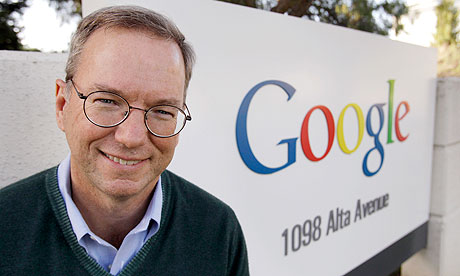
Google Executive Chairman Eric Schmidt sat down and talked to reporters at the Sun Valley conference in Idaho last week, dropping all sorts of science about Google +, Google China and whether or not we are in a tech bubble, among other things. One of the most interesting nuggets of info relayed was the fact that Schmidt could envision startups wanting to build on top of the Google+ platform, which now has 10 million users in its beta but no API in sight.

“You could image the scenario where the social platform is so successful that you’ve got startups that are building on top of Google + that are so incredibly sexy and exciting that we would pay top dollar very fast … That’s a great scenario because then you know you’re winning,” he said.

According to Schmidt, Google M&A made the decision last year to accelerate the acquisitions of companies below the HSR threshold, or the amount that is subject to FTC notification requirements and a waiting period (currently $66 million). Companies like Punchd are being acquired for $10 million, $20 million and $30 million (versus AdMeld’s $400 million) in order to fill out gaps in Google’s strategy, which now includes social.

Earlier in the talk Schmidt also outlined how Google calculated the amount of money it was willing to pay for the company; Namely, the value of a deal equals the value of the team plus the value of the year it would spend a Google team to create the same product. He emphasized that M&A at Google was very bottoms up, “A product manager that has a problem and [needs to] solve that problem” is the raison d’être of a potential acquisition.

You can listen to all of Schmidt’s commentary on Google M&A during the interview in the sound bites clipped together above.

Eric Schmidt: You Don’t Know It’s A Bubble Until The Bubble Ends


Earlier this week, Google Executive Chairman Eric Schmidt gave an over 70 minute long talk to press at the Sun Valley conference here in Idaho. Towards the end of the talk, a reporter asked the former Google CEO whether he, like many in the media world, thinks we are presently in a tech bubble and what Google’s $1.67 billion 2004 IPO at a $23 billion valuation (Google’s current valuation is 171.43 billion) means in light of today’s IPO valuations.

“Oh we were underpriced,” Schmidt joked, before remarking that he didn’t actually know whether or not we are presently in a bubble.

“On the general question of bubble, in the first place you don’t know it’s a bubble until the bubble ends, by definition. The rule I set for myself 10 years ago was that if the press calls it a bubble then I’d pay attention, and let me report that the New York Times, the Wall Street Journal and the Economist have all written articles saying that it’s a bubble.

So you have a couple choices A) The revenue growth possibility on these platforms is so large that you could get the kind of revenue acceleration that justifies the valuations. B) You have a liquidity squeeze where you don’t have enough shares, and they’re artificially high.”

When a journalist pointed out that it sounded like Schmidt was “unconvinced either way,” he said that it’s difficult to know whether the valuations are fair until a significant amount of shares hit the market, usually when employee lockups expire, typically after six months, “You won’t really know the answers until 2012,” he said.

The only clear thing at the moment, Schmidt said, was that real estate values will go up. “Young people who need houses will go into areas of scarce housing resources and there will be competition for houses and housing prices will go up. So for them it’s not a bubble it’s actually a house.”

On what effect if any the seven years of market experience have had on his perspective on Google’s IPO, Schmidt said, “Google went public at a very different time, at what people thought was an unbelievably high valuation, and let me point out that we’ve never traded below our opening price.”

When pressed again by a reporter for a yes or no answer, Schmidt gave the following humble reply, ” I don’t think it’s my job to call the market. It’s a mistake for me to say what the market should think … I’m not a brilliant investor. If I were a brilliant investor then maybe I’d have some status. I’m a computer scientist.” … A computer scientist with a $7 billion net worth.

Are We In A Tech Bubble? Here’s The History [INFOGRAPHIC]

We’ve spent the past year wondering whether we’re currently in a tech bubble akin to the last decade’s dotcom boom.

Mashable has offered facts and opinions on both sides of the question. We’ve heard that the current boom is much different from the heyday of the late 1990s and that we have cause for confidence.

But we’ve also heard (from the likes of legendary investor Warren Buffet, no less) that the newest crop of tech darlings are highly overvalued at worst and unpredictable at best.

And we’ve even asked you, our readers, what you thought about current startup valuations and funding amounts. (Most of you responded that you were not optimistic about the future of the tech startup ecosystem.)

Now here are a few straightforward graphs and charts (created by KISSmetrics and FeeFighters) to help you get some better perspective on the issue. Clearly, the dotcom era was a different beast. But looking back on that insanity should help temper our excitement about new technologies with realistic revenue expectations.


Top image courtesy of iStockphoto, patrickheagney